Know what the number means.
Machine usage, workload reports, provider bills and gateway readings retain their own source, period and scope. ARC1 maps supported records to accountable work and keeps unexplained differences visible.
ARC1 executive brief
Explore the product tourARC1 by LockedIn Labs is the system of record for AI spending decisions. It connects spending to a named workflow, reviewed alternatives, approvals and follow-up evidence, so platform and finance teams can decide what to keep, change or stop.
For leaders accountable for AI investment and the teams responsible for its operation.
The problem
Knowing what AI costs is only the beginning. A team still needs to establish which work produced the spending, who owns that work, whether a change meets its requirements and what happened afterward. Without that connection, a cheaper model can look like a better investment before the evidence supports it.
ARC1 sits alongside existing gateways and evaluation tools, outside the inference path. Each decision retains compared options, approvals, configuration observations and follow-up. Financial review keeps its own evidence; missing links remain explicit.
Why it matters
Platform decisions and financial review retain the context their reviewers need.
Machine usage, workload reports, provider bills and gateway readings retain their own source, period and scope. ARC1 maps supported records to accountable work and keeps unexplained differences visible.
Compare candidates against quality, latency and cost limits set before evaluation. Retain failed and passing comparisons, approval context, configuration and readback. A configuration match is distinct from evidence of requests using it.
Financial views preserve the owner, baseline, relevant costs, outcome evidence and reporting period. Their evidence stays separate from the model-change record, with missing links visible. Forecast, provisional value and finance-confirmed benefit keep their separate meaning.
Inside the record
The retained decision view keeps the workflow and its evidence together. In this synthetic example, spend is still unreconciled. The record makes that gap visible and points the reviewer to the next action.
A proposed change remains a candidate while its evidence is incomplete. Passing an evaluation does not establish a production switch or realized savings.
See the decision in the tour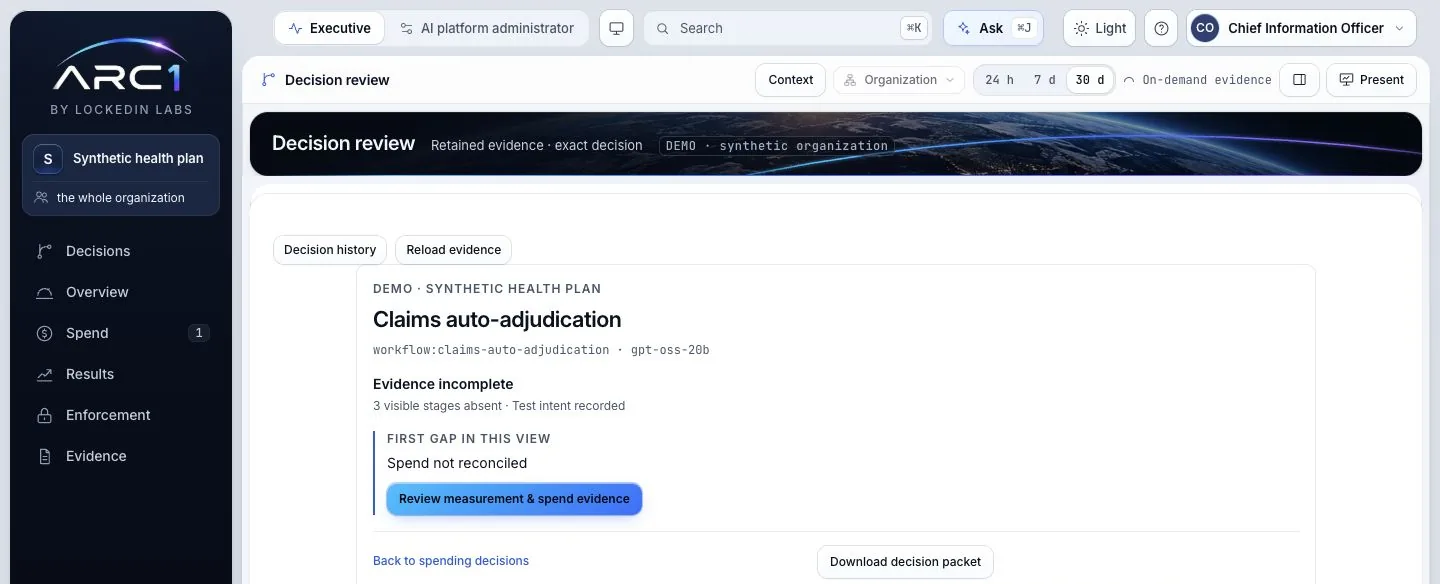
Financial discipline
A lower model price, an accepted outcome and a removed expense answer different questions. ARC1 preserves the status of the claim as the evidence develops.
Incomplete cost coverage remains a cost floor. Retained signatures support evidence integrity under the deployment’s key and custody controls; they do not establish source accuracy or causal attribution.
A focused start
Bring its owner, a proposed change and the evidence needed to evaluate it. A walkthrough shows the decision’s spending context and review, alongside the separate evidence financial follow-up requires, making the next step concrete.
The public tour uses a reference deployment and synthetic data. The supported customer pattern is self-hosted; selected integrations require acceptance in the customer environment. No customer installations or customer savings are established by the demonstration.
arc1.lockedinlabs.ai/brief