AI spend management
AI spend management: build a total you can explain
Before allocating AI cost or claiming an improvement, establish which expenses the total contains, which readings overlap and which costs remain unknown.
Build the inventory before the total.
AI spend management becomes difficult when the same work appears in several places. A provider reports a charge, a gateway measures requests and a coding tool estimates consumption. Meanwhile, a software subscription includes AI features and a shared platform carries compute costs. A tidy dashboard can make these sources look comparable before anyone has established which expenses they represent.
Begin with an inventory of cost streams. Include metered provider charges, software seats, provisioned capacity, commitments, self-hosted compute and AI features inside other software. For each stream, name the owner, source, period, currency and cost basis. Mark whether the amount was collected, imported from billing evidence, declared by an owner or is still unavailable.
This is a scope decision before it is a calculation. A report for direct model charges can be useful if it says so. A report called enterprise AI spend carries a broader expectation. Where the organization cannot size a stream, preserve the gap and assign someone to investigate it. An absent amount should not silently become zero.
Keep charges and observations distinct.
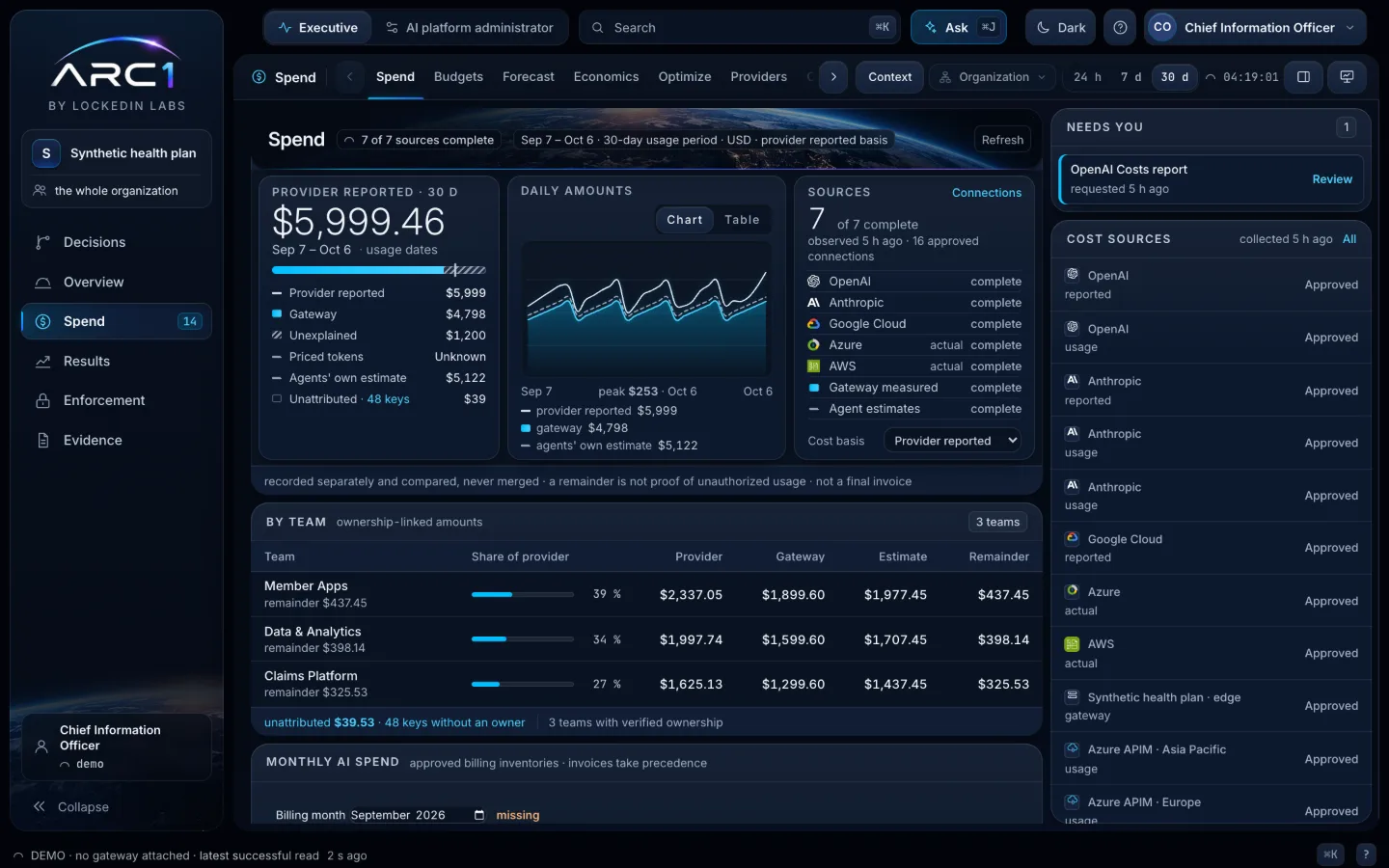
A provider bill establishes a charge under the applicable account and contract. A gateway reading describes traffic that passed through that gateway. An agent estimate describes activity its reporter could observe, priced on its own basis. These readings help explain one another, but adding them together can count the same activity repeatedly.
Preserve each source's meaning during normalization. Actual and amortized cost answer different accounting questions. A usage quantity is not a monetary charge. A credit can reduce a period's net expense without reducing the work performed. Converting these records into a common display format should retain their original basis, source scope and period.
Currency needs the same discipline. Do not sum different currencies under one currency label or infer an exchange rate from a missing amount. A report can keep them apart or use an explicitly approved conversion method with its own date and evidence. ARC1's current coverage calculation is in US dollars; other currencies are not relabeled to fit it.
Explain the coverage denominator.
A coverage percentage is useful only when the reader can reconstruct its denominator. The amount read from provider billing sources can be compared with all the cost streams that can be sized for the selected period. That says how much of the sized estate is supported by billing readings. It does not establish that every possible AI expense is known.
| Evidence | Amount | Treatment |
|---|---|---|
| Provider billing readings | $80,000 | Read and sized |
| Other imported software invoices | $20,000 | Sized; held for review |
| Gateway measurement of the billed traffic | $75,000 | Compared separately |
| AI included in an unreviewed software contract | Unknown | Listed outside the sized denominator |
Here, $80,000 of billing readings divided by $100,000 of sized expense gives 80%. The gateway's $75,000 does not make the total $175,000. The unknown contract remains on the report with a reason and owner. Even a future 100% reading over sized expense would not erase that gap. The example illustrates an accounting boundary, not measured ARC1 performance.
The proportion also needs a meaningful partition. Credits and signed adjustments can produce zero or negative net amounts that make an ordinary percentage misleading. Preserve the exact subtotals and explain why a share does not apply instead of forcing every period into a reassuring progress bar.
Resolve period and overlap before comparison.
A monthly invoice and a rolling 30-day view rarely describe identical dates. Dividing a monthly charge by 30 and spreading it across the view creates precision that the source did not supply. Keep the invoice on its stated month. Use a closed calendar month when the purpose is to reconcile monthly expenses, and retain rolling windows for the operational questions they can support.
Overlapping billing feeds need explicit handling too. The same account may appear in a native cost interface and a normalized billing export. Replacing one with the other requires evidence that the replacement covers the relevant scope and period. A connection being enabled is not proof that the replacement reading exists or is complete.
Changing source coverage can change a trend without changing the business. A newly connected subscription raises observed spend even if its contract is unchanged. A delayed billing feed can make the current period appear cheaper. Put coverage changes and freshness beside the movement before asking a department to explain it.
Separate financial coverage from ownership.
Knowing the charge and knowing who caused it are separate achievements. A complete provider reading can still contain shared keys with no reliable team assignment. Keep that amount unattributed until an ownership rule or source dimension supports the assignment. An attractive allocation is not worth losing the ability to reproduce it.
Use the available hierarchy deliberately: organization, department, team, application and project where evidence supports that depth. Shared platform cost may need an agreed allocation rule rather than a guessed user identity. Record the rule, its owner and the period it applies to, and give cost owners a way to question it.
Once coverage and ownership are clear, review the work behind the expense. Compare accepted volume, quality and review effort with a consistent cost boundary. A higher bill can support valuable growth; a lower one can reflect missing data or displaced work. The next budget decision should follow those explanations rather than reward the direction of a single number.
Make the next review reproducible.
ARC1 keeps provider-billed, gateway-measured and estimated readings separate. Its coverage view records sized, compared and unsized streams, preserves source periods and identifies unavailable evidence. Billing selection checks scope-qualified overlaps and eligible replacements rather than assuming every connected feed adds new expense. Supported billing normalization retains the cost basis; it does not manufacture attribution or turn telemetry into an invoice.
Its hosted reference deployment uses a fictional health plan and labeled synthetic data. A customer review depends on the sources connected and accepted in that customer's environment. Use the visibility documentation to establish what a reading represents, then take a closed period into the financial close. Forecasts, operating estimates and finance-confirmed results need their own evidence.
A useful first review can be small: one month, the known billing inventory and a list of unresolved streams. Ask the owner of each gap what evidence would resolve it. That gives the next meeting a concrete improvement to inspect, and gives finance a total whose boundaries remain understandable when the number changes.
Related evidence & documentation
- Visibility, source coverage and observation boundaries
- Enterprise AI utilization and ownership
- Closing the month on AI
- Financial evidence beyond delivery
Original editorial by Sam Sweilem, LockedIn Labs. Product capability descriptions reviewed against ARC1 documentation and implementation on October 29, 2026. Worked examples and proposed operating methods are illustrative.