Enterprise token management
Enterprise token management: budgets before dispatch
A token limit becomes useful when the organization can explain who it applies to, what it counts and what happens while work is still running.
Give the budget an operating scope.
Enterprise token management starts with a practical decision: how much AI work should this team, application or person be allowed to initiate before someone reviews it? A monthly consumption chart helps answer that question after the work has happened. An operating budget also needs a rule for the next request, including the requests already running when the chart was last updated.
Begin with an accountable owner and a defined workload. A shared service may need an application allowance because several teams use it. A development team may need a group allowance because its members draw on the same investment. A personal limit can be useful within that structure, but it should not become a ranking of employees by tokens consumed. Different jobs require different amounts of exploration, context and review.
Write down the period, eligible traffic and response when the limit is approached. State whether the budget measures tokens, dollars or both. Tokens describe consumption; dollars depend on the applicable price and token class. Neither establishes the value of the completed work. Keep the acceptance standard for that work beside the allowance.
Choose what the control will do.
Observation, warning and enforcement serve different purposes. Observation shows whether a proposed allowance fits actual demand. A warning asks the owner to investigate while work continues. Enforcement can refuse a new request when it does not fit the remaining allowance. Calling all three a budget without naming the mode leaves the operator guessing when an intervention is needed.
Use the observation period to examine normal variation. A release week, a long document or a difficult investigation may consume more than an ordinary day. Decide what deserves a larger allowance and what deserves a workflow change. A lower limit can suppress useful work just as easily as waste if the decision is made from a total alone.
The control must also be on the traffic path it governs. A rule saved in a console cannot constrain a request that bypasses its enforcement point. Configuration readback establishes what a supported target holds; an observed refusal provides different evidence about what happened to a request. Both belong in a rollout review.
Reserve capacity before dispatch.
A request does not reveal its final consumption before it runs. To make an admission decision, an enforcement point needs a bounded reservation for the work it is about to send. That reservation occupies capacity until the request settles. The account therefore contains settled usage and outstanding holds, rather than a single historical total.
| Allowance reading | Amount |
|---|---|
| Monthly limit | 100 |
| Settled usage | 60 |
| Outstanding reservations | 25 |
| Available for another reservation | 15 |
| Next request's reservation | 20 |
The next request cannot fit even though settled usage is only 60. If the outstanding work later settles at 10 instead of its reserved 25, the account becomes 70 settled with no holds, leaving 30 available. The request may then fit if the allowance and other conditions remain unchanged. This arithmetic illustrates admission; it is not a claim about a customer workload.
A request whose consumption cannot be bounded needs a separate decision. Treating unknown media or an absent price as zero would make the allowance appear to work while removing its basis. The supported path should establish an approved bound or refuse admission under the relevant enforcement rule.
Account for work already in flight.
Concurrent work makes a naive remaining-balance check unreliable. Several requests can see the same headroom and each assume it is available. Reservations need a shared ledger with atomic updates wherever replicas share an allowance. A separate limit on requests in flight can bound the amount of work exposed before settlement arrives.
Settlement still matters. Reported usage can exceed the reservation, so an admission budget is not a promise to stop at the last token or cent. Charge the observed settlement, retain the overage and evaluate subsequent requests against the updated account. An organization that needs a strict financial guarantee must examine that requirement separately.
Keep ledger scope visible. Two independent gateways with the same configured limit do not necessarily share one counter. Adding overlapping person and team balances can also produce a misleading organization total. Ask which requests share state, how period boundaries work and how stale or missing readings are shown.
Connect limits to accepted work.
The next review should ask what the allowance bought. Compare accepted outcomes, quality, retries and review effort over a consistent period. A team approaching its limit may have growing demand worth funding. It may instead be resending context, repeating failed work or running unattended jobs with no current owner. Each explanation needs a different response.
Preserve token classes when interpreting efficiency. Cache reads, cache creation, ordinary input and output can have different economics. A declining token total is not sufficient evidence of a cheaper workflow, particularly if human correction increases. The useful comparison is cost per accepted outcome within a stated cost boundary.
A refused request is an operational event, not automatically a saving. The work might move to another service, wait until the next period or require manual completion. Finance can recognize an expense reduction when the relevant financial evidence supports it. Keep that conclusion separate from the budget's admission record.
How ARC1 applies this method.
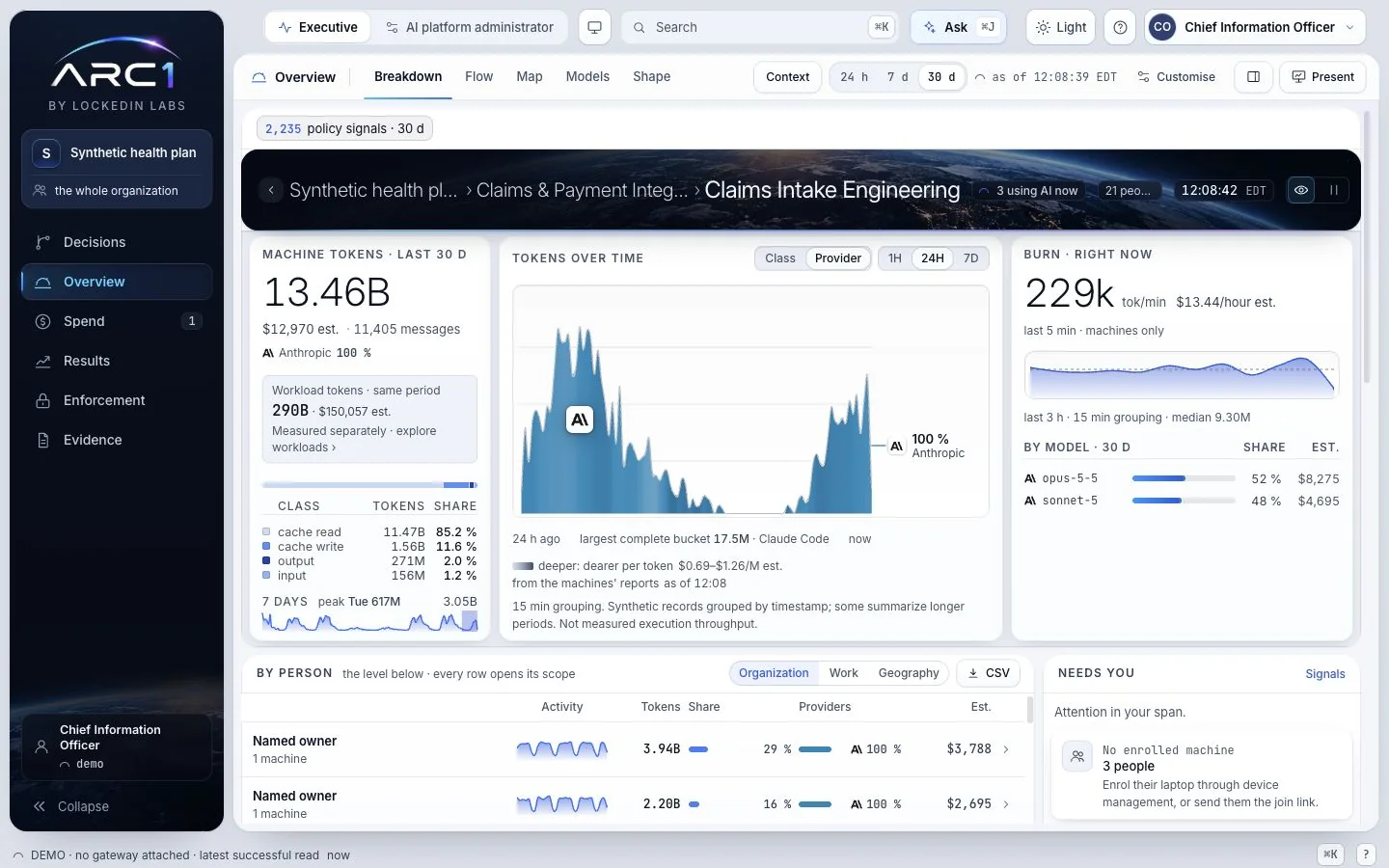
ARC1 supports approved allowances for people, groups and applications, with token and dollar dimensions and observation, warning or enforcement modes. Its native gateway implements reservation and settlement; signed balance readings distinguish settled charges, holds and freshness. Authoring and approval run in the released hub on synthetic demonstration data. Native gateway admission is built and lab-tested against a stand-in provider; activation requires deploying that gateway and routing the intended traffic through it. It is not a universal stop across provider billing.
Start with one owned workload, an observation period and a review date. Approve the intended change, confirm the target configuration and inspect behavior before expanding scope. The budget documentation identifies the current capability boundaries. A manageable allowance is one the next operator can explain and the workload owner can revise from evidence.
Related evidence & documentation
- Budgets, allowances and current deployment status
- Policy rollout, configuration readback and observed behavior
- Cost per accepted outcome
Original editorial by Sam Sweilem, LockedIn Labs. Product capability descriptions reviewed against ARC1 documentation and implementation on October 29, 2026. Worked examples and proposed operating methods are illustrative.